Mr. Tremblay's Class Site
  • Home
  • CIE
  • Rules & Procedures
  • 2F - 2FA/B/C
    • Syllabus
    • Homework
    • 2F Chemistry>
      • C7. The structure of the atom
      • C8. The periodic table & C10. Patterns of reactivity
      • C8-1 Metal Magazine Project
      • C9. Endothermic and Exothermic Reactions
      • C11. Preparing common salts
      • C12. Rates of reaction
      • C12-1 Alchemy Project
    • 2F Physics>
      • P13. Density
      • P14. Pressure
      • P15. Turning on a pivot
      • P16. Electrostatics
      • P17. Electricity
    • 2F Mock Exam 2013
    • 2F Exam Revision
  • 3F - 3.1/2/3
    • Syllabus
    • Schedule
    • Homework
    • P1. Motion
    • P2. Matter and Forces
    • P3. Energy, Work & Power
    • P4. Simple kinetic molecular model of matter
    • P5. Matter and Thermal Properties
    • P6. Transfer of thermal energy
    • P7. Waves
    • P8. Light
    • P9. Electromagnetic Spectrum
    • 3F Exam Revision
  • 4F - 4.1/2/3
    • Syllabus
    • Schedule
    • Homework
    • P10. Sound
    • P11. Magnetism
    • P12. Electricity
    • P13. Electric circuits
    • P14. Electromagnetic Effects
    • P15. Radioactivity
    • 4F IGCSE Exam Revision
    • IGCSE Exam Schedule
  • 4F Chemistry
    • Syllabus
    • Schedule
    • Homework
    • C1. Nature of matter >
      • Nature of matter Revision
    • C2. Experimental techniques
    • C4. Stoichiometry
    • C5. Electricity and chemistry
    • C6. Energy changes in chemical reactions
    • C7. Chemical reactions
    • Glossary
    • IGCSE Chemistry Revision
  • 5F - AS Physics
    • Syllabus
    • Schedule
    • Homework
    • Unit 1: Quantities & their measurement >
      • 1. Physical quantities and units
      • 2. Measurement techniques
    • Unit 2: Motion, force & energy >
      • 3. Kinematics
      • 4. Dynamics
      • 5. Forces
      • 6. Work, energy, power
    • Unit 3: Matter>
      • 9. Phases of matter
      • 10. Deformation of solids
    • Unit 4: Electric charge >
      • 17. Electric fields
      • 19. Current of electricity
    • Unit 5: Waves >
      • 15. Waves
      • 16. Superposition
    • Unit 6: Atomic Physics >
      • 27. Nuclear physics
    • Materials Physics Project
    • Adaptive Quiz- AS Physics
    • Useful Websites
  • 2013 Mock Exams
    • 2013 Mock Exams Schedule
    • 2F Mock Exam 2013
    • 4.1 & 4.2 Mock Exams
    • AS PHYS Mock Exams
  • 2013 CIE Exams
  • Past Exam Papers
    • Checkpoint Science (1113)
    • IGCSE Coordinated Sciences (0654)
    • AS Physics (9702)
  • Glossary
  • Formula Sheets
  • Periodic Table
  • Lab Handbook
    • Graphs
  • Scientific Calculator
  • Videos & Docs
  • Links
  • Submit Files
  • Contact Me
Picture
Notes
Picture
Labs
Picture
Links
Picture
CIE

P1. Motion

Picture
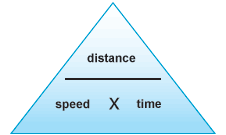
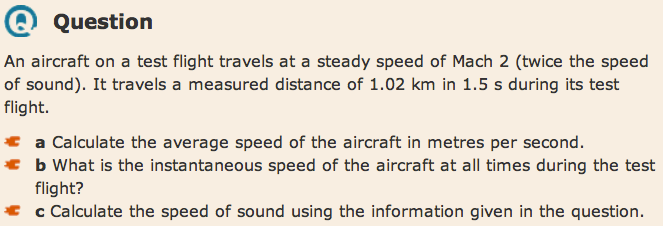
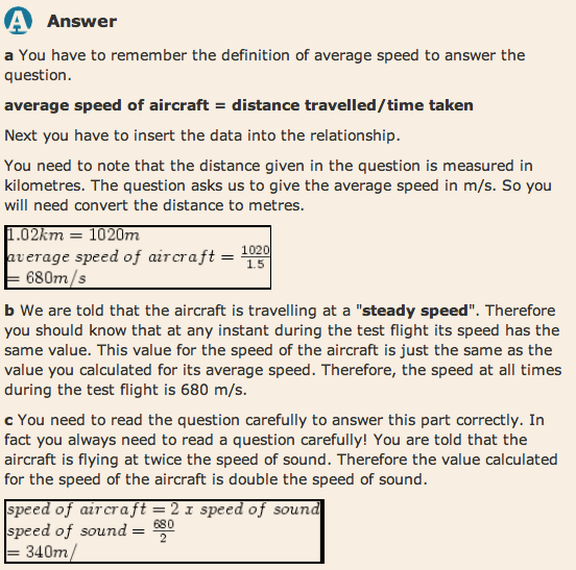
P1-1:  Define speed and calculate speed from (total distance / 
            total time)
Picture
Picture
Picture
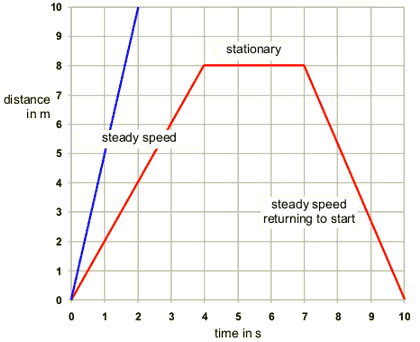
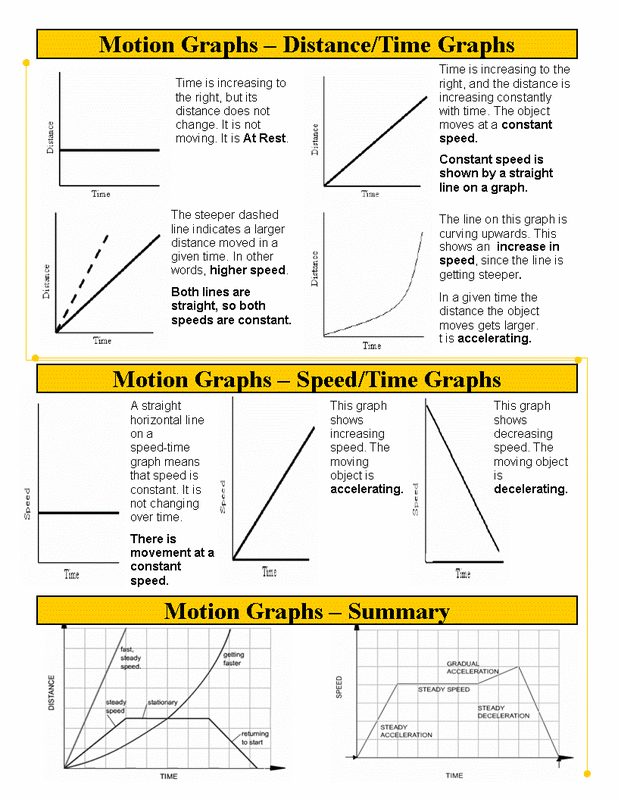
P1-3  Plot and interpret a speed/time graph and a distance/time  graph
P1-4  Recognise from the shape of a speed/time graph when a 
          body is:
          • at rest
          • moving with constant speed
          • moving with changing speed   
Picture
Picture
Picture


Motion graph summary

On a displacement-time graph …
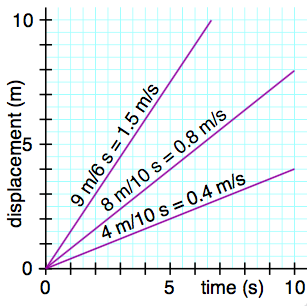
  • slope equals velocity.
  • the "y" intercept equals the initial displacement.
  • straight lines imply constant velocity.
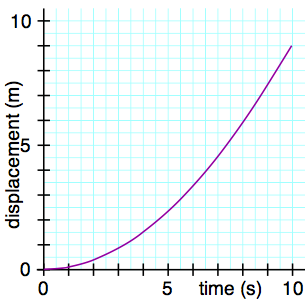
  • curved lines imply acceleration.
  • an object undergoing constant acceleration traces a portion of a parabola.
  • average velocity is the slope of the straight line connecting the endpoints of a curve.
  • instantaneous velocity is the slope of the line tangent to a curve at any point.
  • positive slope implies motion in the positive direction.
  • negative slope implies motion in the negative direction.
  • zero slope implies a state of rest.
  • The area under the curve is meaningless


On a velocity(speed)-time graph …
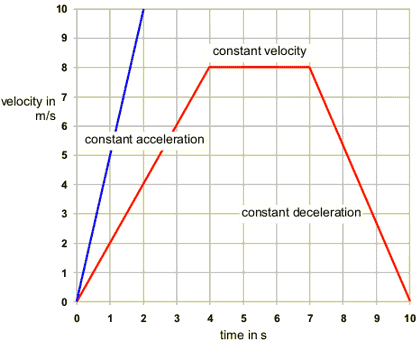
  • slope equals acceleration.
  • the"y" intercept equals the initial velocity.
  • straight lines imply uniform acceleration.
  • curved lines imply non-uniform acceleration.
  • an object undergoing constant acceleration traces a straight line.
  • average acceleration is the slope of the straight line connecting the endpoints of a curve.
  • instantaneous acceleration is the slope of the line tangent to a curve at any point.
  • positive slope implies an increase in velocity in the positive direction.
  • negative slope implies an increase in velocity in the negative direction.
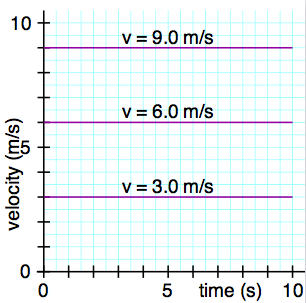
  • zero slope implies motion with constant velocity.
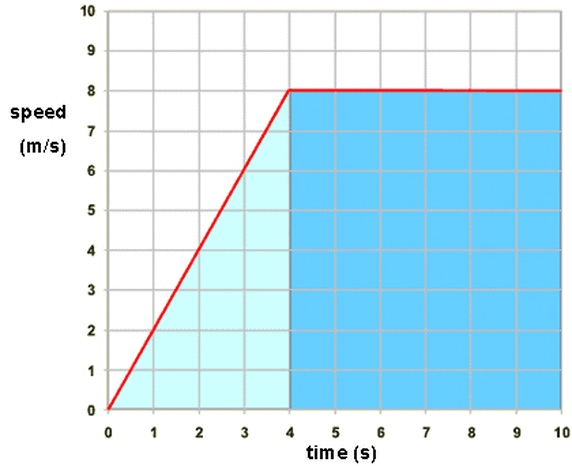
  • the area under the curve equals the change in displacement.
Picture
Picture
 
Picture
Picture
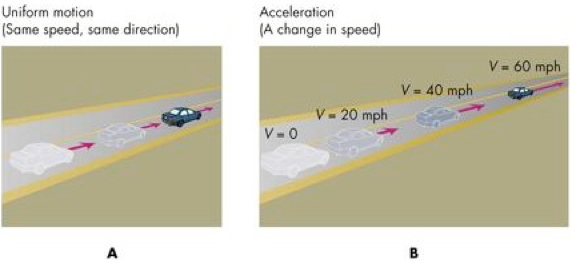
P1-8  Demonstrate a qualitative understanding that acceleration 
           is related to changing speed.    

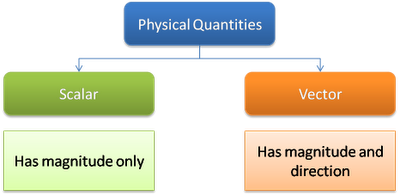
When velocity is changing, the word acceleration is used. Acceleration is also a vector. You speed up if the acceleration and velocity point in the same direction. You slow down (also referred to as decelerating) if the acceleration and velocity point in opposite directions. When you accelerate or decelerate, you change your velocity by a specific amount over a specific amount of time. 
Picture

P1-2:  Distinguish between speed and velocity
Picture
P1-5  Recognise linear motion for which the acceleration is 
          constant and calculate the acceleration

P1-6  Recognise motion for which the acceleration is not 

          constant

P1-7  Calculate the area under a speed/time graph to work out 

          the distance travelled for motion with constant 
          acceleration
Picture
Acceleration

In everyday language we use 'accelerate' to mean speeding up and 'decelerate' to mean slowing down. In scientific terms 'acceleration' is the rate at which something changes its speed - faster or slower.

Acceleration depends on two things:

  • How much the speed changes
  • How much time the change in speed takes

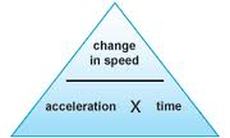
Calculating acceleration


acceleration = change in speed / time taken

Example- A bus accelerates from 5 m/s to 25 m/s in 10s

To calculate its acceleration, first find the change in speed.

This is 25m/s - 5m/s = 20m/s

Acceleration = 20m/s ÷ 10s = 2m/s2
Picture

Revision

Speed, velocity & acceleration Revision Site
Print Friendly and PDF
Powered by Create your own unique website with customizable templates.